

Understanding Career Congruence: Finding Your Fit

Updated: May 6
What is Career Congruence?
Career congruence is about whether your work aligns with who you are, what matters to you, and the life you aspire to lead.
It’s the difference between a career that looks good on paper and one that feels right in your daily life.
Many people invest years in building careers that seem sensible. The roles appear impressive, the progression is clear, and the responsibilities carry weight. Others notice your achievements. It’s credible and solid.
And often, you excel in your role.
But excelling and feeling fulfilled are not the same.
This is where the shift often begins. Not because something has gone wrong, but because something within you has changed.
When Your Work No Longer Fits
You can still perform your job. You can still deliver results, show up, and meet expectations.
Yet, something feels different.
There’s a subtle sense of effort that wasn’t there before. You might feel like you’re a bit more “on” than usual. It’s as if you’re working harder to be the version of yourself that your role demands.
It’s not a dramatic change, but it’s there.
Over time, the gap between who you are and how you present yourself becomes significant.
When we view our careers solely in terms of roles, titles, or progression, it’s easy to overlook the deeper changes happening within us.
The real question is: does this way of working still fit the person I am now?
Why Incongruence is Often Overlooked
Most people first recognise congruence by experiencing its opposite: incongruence.
Incongruence doesn’t usually make a grand entrance. It’s much quieter than that.
You might find yourself saying one thing while thinking another. You may adapt so seamlessly to expectations that you stop checking in with your true desires. Perhaps you achieve a goal you’ve worked hard for, only to feel flat once you get there.
None of this appears problematic from the outside.
But it alters how the work feels.
If this continues over time, it can affect more than just your job. It can impact your energy, confidence, motivation, and even your self-perception. Not because you’re doing anything wrong, but because your way of working no longer resonates with who you are.
What Congruence Feels Like in Practice
Congruence isn’t a grand revelation.
It’s often something you sense in everyday moments.
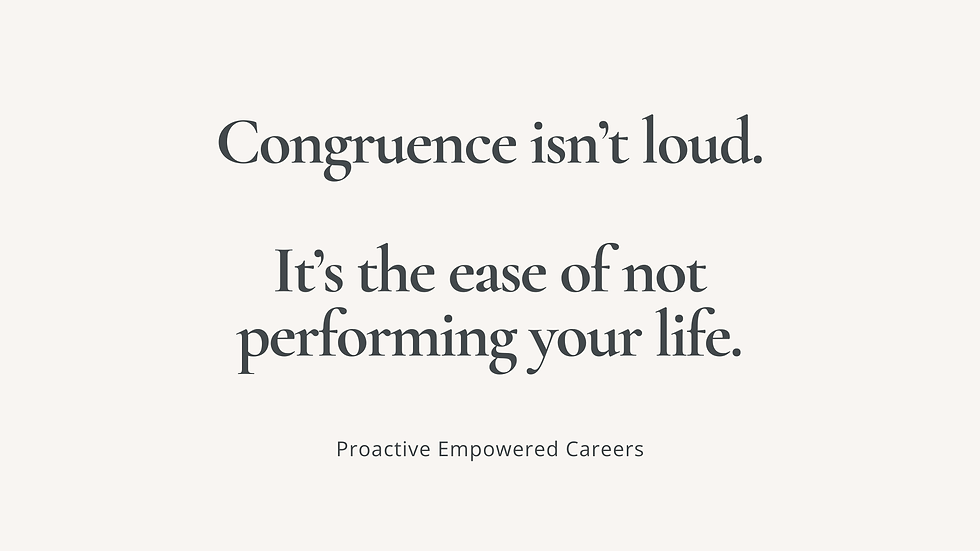
It can feel like ease. Like you’re not constantly second-guessing yourself. You don’t have to adjust how you present yourself or edit your thoughts.
It can feel like being able to focus on your work without being pulled in multiple directions.
One of the simplest ways to grasp this is through energy.
When your work aligns with who you are, you expend less energy managing your persona.
You’re not always contemplating how to respond, how to sound, or if you’re doing it right. You’re not translating your genuine thoughts into something more palatable.
That energy becomes available again.
And you notice it—in your thoughts, contributions, connections, and how sustainable your work truly feels.
Recognising Congruence in Your Career
Career congruence isn’t abstract; it manifests in practical ways.
You can observe it in what captures your attention and what drains it. In the environments where you feel authentic and those where you don’t.
You can feel it in your decisions. Some feel clear, even if they’re challenging. Others feel heavy, as if you’re trying to convince yourself.
You’ll also notice it in smaller moments. Instances that feel slightly off, even if they’re not significant enough to act on immediately.
These moments deserve your attention.
Over time, careers are shaped less by one monumental decision and more by what you consistently notice and how you choose to respond.
This is where it becomes practical. It’s not about getting everything right. It’s about being honest about your experiences and allowing that to guide your direction.
Why Moving Towards Congruence Can Feel Uncomfortable
Moving towards something that fits you better doesn’t always feel easy.
If you’ve spent years being capable, reliable, and responsive to expectations, this can feel unfamiliar.
Now, you’re not just responding to what’s needed. You’re also responding to yourself.
Your preferences.
Your values.
What matters to you now.
This brings responsibility.
You begin to see more clearly what fits and what doesn’t. Once you see it, it’s harder to ignore. That’s often where discomfort lies—not in the change itself, but in what that clarity demands from you.
This Isn’t a One-Time Decision
Career congruence isn’t a one-off discovery.
You change.
Your life changes.
Your priorities shift.
What worked well for you five years ago may not feel right now. That doesn’t mean it was wrong; it simply means you’ve evolved.
So the focus isn’t on finding a fixed answer.
It’s about staying connected to yourself enough to notice when the fit changes.
What still feels right?
What no longer resonates?
What energises you?
What quietly drains you?
This awareness allows your career to evolve in a way that genuinely reflects you.
A More Useful Way to Think About Your Career
Career congruence offers a fresh perspective on your work.
Not just in terms of success, but in terms of fit.
Not just what you can achieve, but what you can genuinely sustain and recognise yourself in.
If something in your work no longer feels quite right, it doesn’t always mean you need to make an immediate, drastic change.
But it usually indicates that something requires your attention. And that’s worth taking seriously.
This article is based on Episode 9 of the Proactive Empowered Careers® podcast, where I explore the idea of career congruence in more depth.
🎧 You can listen to the episode below ⬇️


Comments